
The BlueSenseManager research project investigates and optimizes the energy requirements and management of wireless sensor and beacon networks based on Bluetooth Smart technology (also known as Bluetooth Low Energy, or BLE for short). To this end, the project focuses on the energy-efficient operation and management of a beacon network for indoor localization as an example. However, the results are also applicable to other BLE-based sensors, beacons, and sensor networks.
Technical Fundamentals
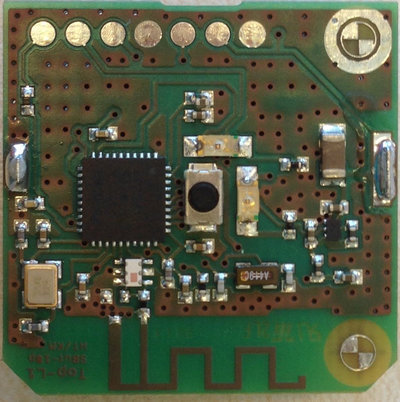
Although the Bluetooth Smart (Bluetooth Low Energy) wireless standard is still relatively new, it is already widely used in nearly all modern smartphones. It offers a number of advantages for applications in the “Internet of Things” (IoT) sector, such as smart devices and sensors or indoor localization:
- BLE is a recognized standard supported by many manufacturers.
- Components for BLE-enabled devices—which connect a wireless modem to a low-power microcontroller—are readily available from several manufacturers at low cost. Ready-made modules with FCC and CE certification are also available (Fig.: BluLOC Beacon)
- BLE promises very high energy efficiency. This enables devices that can operate for many months or even several years on low-capacity batteries. A connection to the power grid is not necessary, which keeps installation costs extremely low.
- Many potential users already have a companion device for BLE-enabled devices in the form of their smartphones. Through special apps, smartphones enable interaction with BLE devices—for example, to read sensor data, program devices, or connect an IoT-enabled device to the cloud.
So-called beacons are a specialized application for very simple BLE devices specified by Apple. Beacons can be used, for example, for indoor localization: a smartphone detects signals from nearby beacons, estimates the distance to the beacons based on the received signal strength, and uses a map showing beacon locations to determine its own position.
Problem Statement
One of the biggest obstacles to using BLE devices, such as beacons, is battery replacement, which involves a significant amount of manual labor in large installations. The need for a battery replacement is usually only recognized once a beacon fails. The power consumption of BLE devices is often higher than expected in real-world applications, which exacerbates the problem. Therefore, it is desirable to have, on the one hand, intelligent management of BLE devices aimed at optimizing energy consumption and, on the other hand, centralized monitoring of the network status. Both measures improve the maintainability of the installation and lead to lower operating costs.
Approach to a Solution
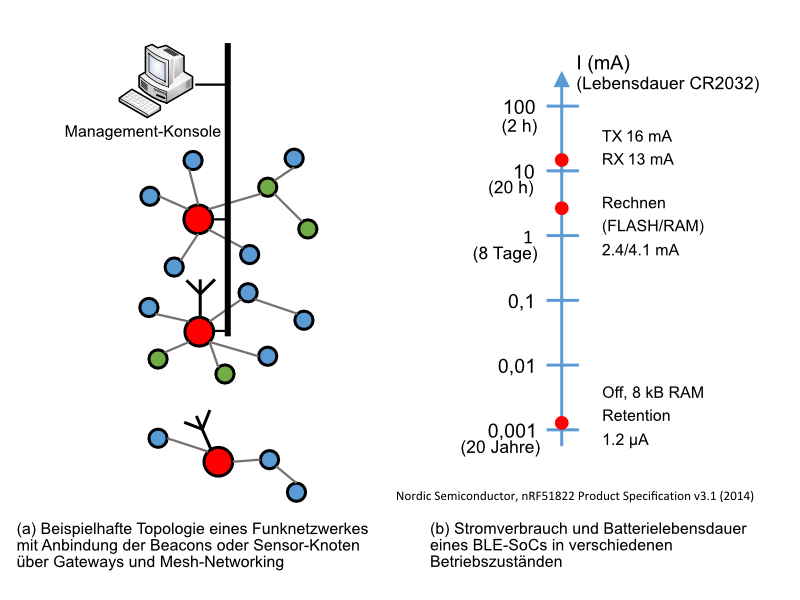
- Detailed measurement and modeling of the power consumption profiles of various BLE SoCs
- Development of strategies for optimizing power consumption through intelligent control of communication parameters
- Development of a BLE gateway for network management
- Investigation of mesh communication for network management
Funding
Internal University Funding (HIFF)
Collaborations
We are interested in collaborative projects with partners from industry and research. If you are interested, please contact Prof. Dr. Fühner.
Abschlussarbeiten
Thesis topics are available as part of the research project; if you are interested, please contact Prof. Dr. Fühner or Prof. Dr. Röhrig.