
Motivation
The umbrella term “Ambient Assisted Living” (AAL) refers to the development of technical support systems designed to enable older adults to live safely at home. The focus is on providing convenient support and rapid assistance in emergency situations. To date, only a few AAL systems are commercially available; due to their limited functionality, they have not become widely adopted and are generally very costly as custom solutions.
Objective
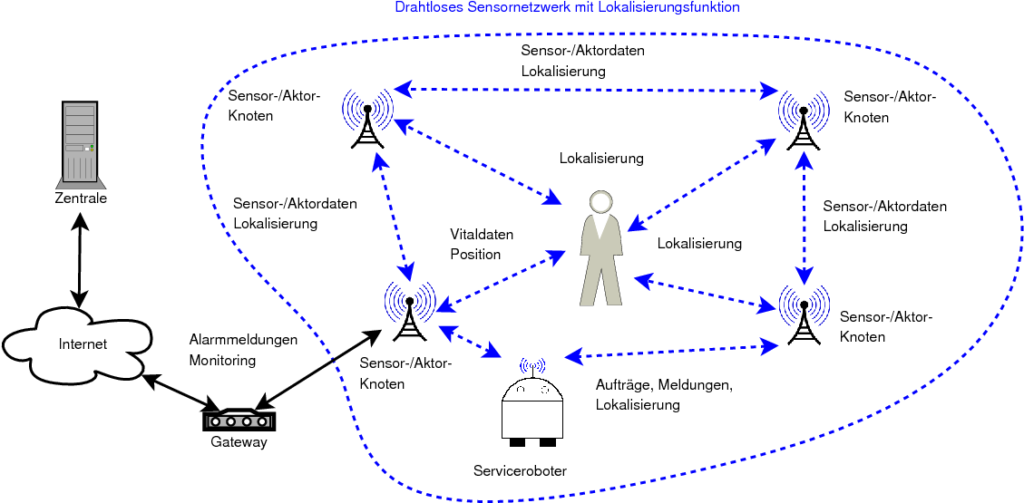
The goal of the project is to develop a prototype assistance system based on the use of wireless sensor networks, which can therefore be easily retrofitted into existing homes. The wireless sensor network is used to collect sensor data such as room temperature, light levels, etc., and consists of both stationary sensor nodes and wireless gateways as well as mobile nodes, such as tags for fall detection. In the home environment in particular, emergency prevention and detection are top priorities. Emergencies should be quickly detected through the fusion of sensor data, and help should be summoned via the Internet or the cellular network. In addition to falls, emergencies to be detected include water leaks (e.g., an overflowing bathtub), forgotten electrical appliances (irons, stoves), smoke (fires, forgotten candles), and open windows when leaving the home. In addition to direct hazard detection, the activity of the individuals being cared for is also monitored. Any deviation from their usual behavior can then be detected and reported to family members. This can, for example, help identify the progression of dementia.
Key Areas
The prototype to be developed differs significantly in two respects from commercially available systems and also from systems that have been developed as prototypes to date: First, the system should not be limited to the use of a specific wireless standard. Various wireless technologies are currently used commercially for different types of sensors. The goal is to develop wireless gateways that support major wireless standards and can thus utilize sensors from different manufacturers and based on different wireless standards. At present, the integration of the radio technologies IEEE 802.15.4 and IEEE 802.15.4a, Bluetooth and Bluetooth Low Energy (BLE), as well as EnOcean, is considered appropriate. Research among sensor and radio module suppliers will determine which radio technologies should be implemented in the first prototype of the gateway.
The second key differentiating feature of the AAL system is said to be the use of the IEEE 802.15.4a wireless standard as the wireless backbone and the resulting ability to locate wireless nodes and individuals. The localization function of the wireless sensor network can facilitate easy commissioning. This function enables more granular activity monitoring than previous systems, which can also be used for semi-automatic commissioning that involves self-learning of the user’s lifestyle habits.
Funding
Internal University Funding (HIFF)