
Abstract
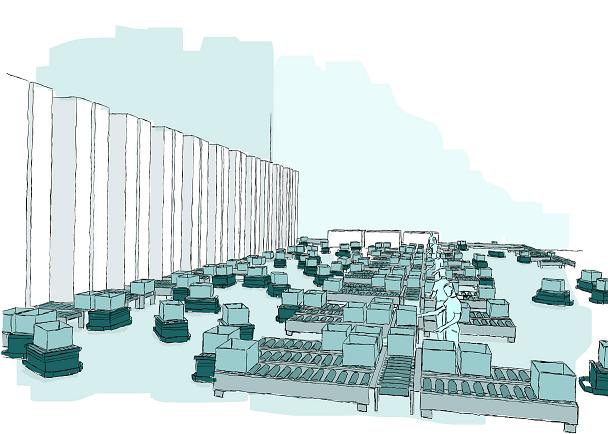
Autonomous guided vehicles (AGVs) are used to transport logistics items such as pallets and containers. In the automation of intra-facility material flow, they are considered the technology that offers operators the highest degree of flexibility. The goal of current research is to replace conventional continuous conveyor technology with a group of compact and cost-effective AGVs—essentially a swarm of AGVs. The advantage of this entirely new technology lies in the increased flexibility and scalability of material flow systems.
Background and Objectives of the Research Topic
In collaboration with the Fraunhofer Institute for Material Flow and Logistics (IML) in Dortmund, the project aims to investigate the localization of FTFs using nanoLOC technology. The nanoLOC system is a wireless sensor network that can be used for real-time positioning. To this end, Fraunhofer IML plans to set up such a cellular transport system. In this context, the Mobile Business Mobile Systems research focus is addressing the development of near-real-time, decentralized control. To this end, a protocol for communication between the individual sensor nodes is being developed. However, the indoor localization accuracy of 2 meters specified by Nanotron is far from sufficient for applications in intralogistics. The goal of the research focus is now to optimize this accuracy—by improving the algorithms and incorporating additional sensor data—to the point where the accuracy required for FTF navigation is achieved.
Key Areas
To achieve the required localization accuracy, extensive investigations into the accuracy of the nanoLOC system’s distance measurements must first be conducted.
Based on the results of the distance measurements, algorithms for localization and position tracking will be developed. These algorithms must be adapted so that measurement errors caused by multipath propagation can be detected and corrected.
Another component of the research project is the development of a communication structure for a large number of AGVs. Such a system has not yet been implemented. The specific challenges lie in the high volume of communication traffic resulting from the vehicles’ continuous distance measurements to the anchor nodes, which are also subject to precise timing constraints due to the localization algorithms.
Once the developed algorithms and the communication structure have been successfully implemented on the AGVs, the entire cellular transport system will be analyzed and optimized.
Partners

Dipl.-Ing. Hubert Büchter

Funding