Project Goal
The goal of the project is to develop omnidirectional autonomous guided vehicles (AGVs) that can automatically transport loads in warehouses, distribution centers, or production facilities. The vehicles should be capable of being integrated into an automated guided vehicle system (AGV system).
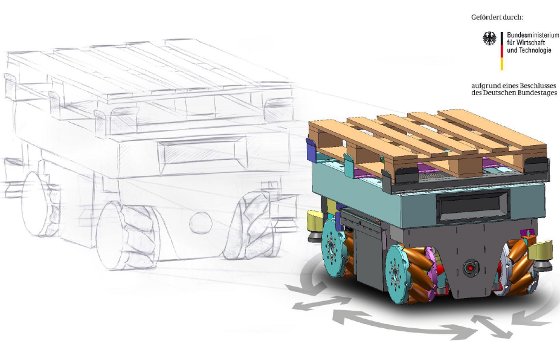
A Mecanum drive system is intended to provide the AGV with omnidirectional mobility, offering improved maneuverability compared to conventional AGVs that move along fixed paths, and thus greater flexibility in confined spaces. This omnidirectional mobility enables the AGV to perform transport tasks that are not possible with conventional AGVs in confined spaces.
A novel localization method is intended to enable the AGV to navigate and avoid collisions even in confined spaces without the usual need for lane guidance. The new AGV system to be developed is intended to take over automated transport tasks in production and intralogistics that previously had to be performed manually. This makes it possible to automate transport tasks, particularly in facilities that were not originally designed for AGVs. Automatic collision avoidance allows the AGV to navigate around obstacles that partially block the path—obstacles that would otherwise halt the entire transport process if the vehicle were a line-guided AGV with optical tracking.
Project Partners
The project partner in this collaborative project is imetron Gesellschaft für industrielle Mechatronik mbH. imetron is responsible for mechanical and mechatronic development as well as system integration in the project.The automated guided vehicle (AGV) system being developed as part of the project is marketed by imetron (see link).


Project Results
The project involves the development of two prototypes of omnidirectional FTFs. The larger FTF is designed to transport Euro pallets in stacks, while the smaller vehicle is designed to transport Euro containers (60 cm x 40 cm). Thanks to the Euro standard dimensions, it is also possible to transport two containers with base dimensions of 40 cm x 30 cm (see figure).
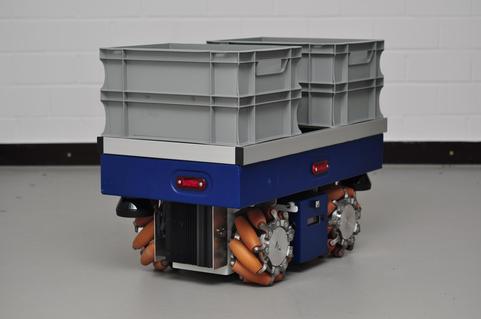
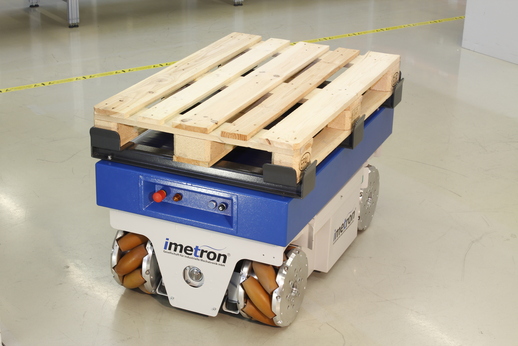
The vehicles are intended to form the basis for a product family that can be used for internal logistics processes. Their modular design allows them to be adapted to different logistics processes. Together with a transport control system, the Mecanum-driven AGVs form an automated guided vehicle (AGV) system that can be flexibly adapted to the needs of the operators.
The larger Mecanum FTF for transporting EUR pallets delivers outstanding performance. Within its compact dimensions—barely larger than the EUR pallet itself—a vehicle has been designed that easily supports the maximum load capacity of a standard EUR pallet, which is 2 metric tons. The driving dynamics of the pallet AGV are very robust; obstacles the size of a cigarette pack can be easily navigated without the Mecanum drive deviating significantly from its path.
The compact small-scale AGV for transporting KLT containers is powered by Mecanum wheels with a diameter of just 190 mm, which offer exceptionally low-vibration concentricity compared to the state of the art. The diameter is determined by standardized safety requirements for AGVs. For example, the safety laser scanners used for personal protection require a 360° all-around field of view at a height of 200 mm above the ground. Despite the wheel’s compact dimensions, a load capacity of over 270 kg per wheel has been achieved. The wheel is part of a compact Mecanum wheel drive unit that can be used modularly in a wide variety of vehicle designs.
Videos
The video shows pallet transport at the 2015 Hannover Messe
Watch more on the DonkeyMotion by Imetron YouTube channel.
Funding