
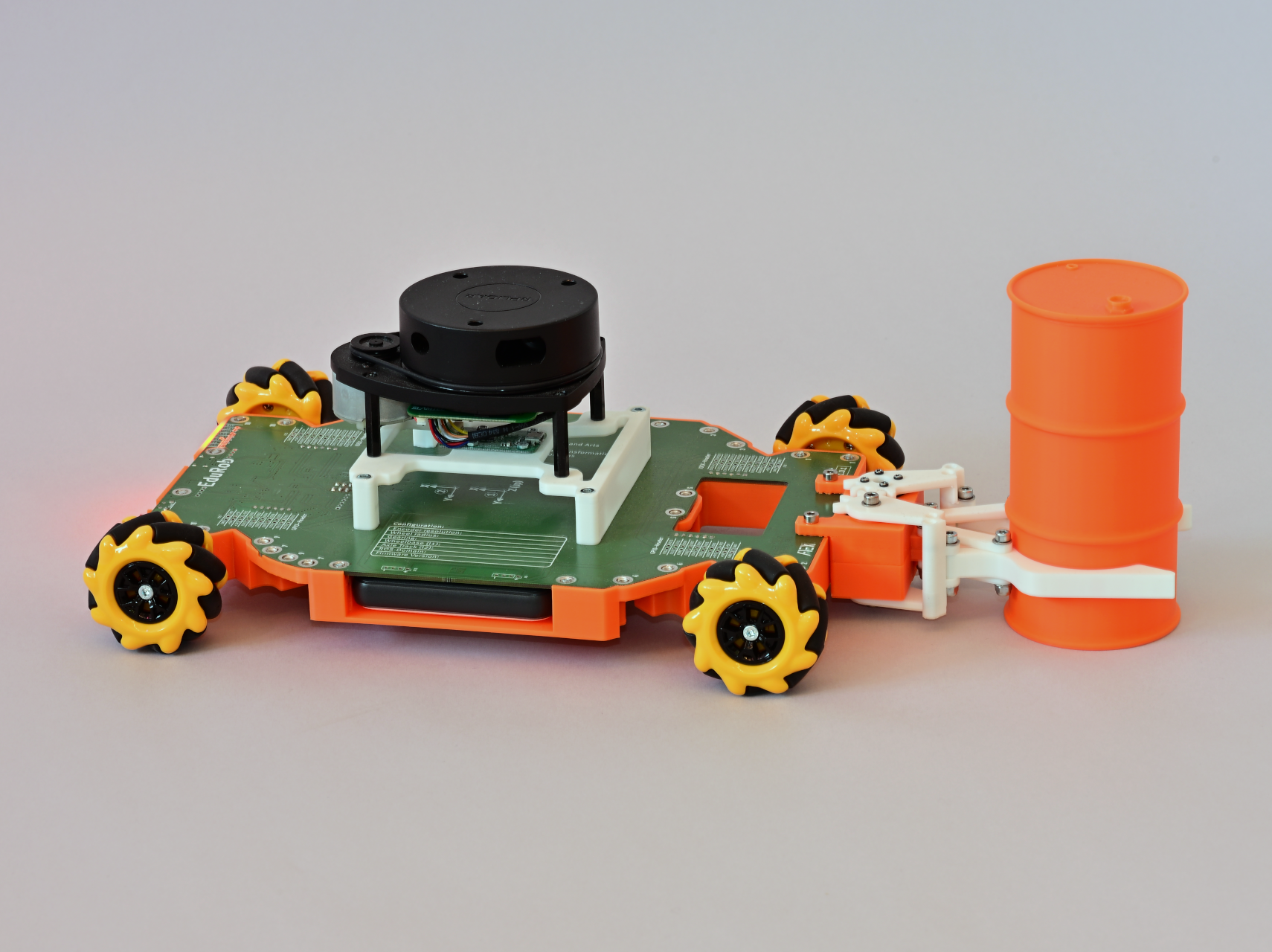
EduRob is a compact, mobile robot specifically designed for teaching. Thanks to its clever design, it can accommodate various drive types, such as Mecanum, omni-wheel, and differential drive.
Github Projekt: https://github.com/IDiAL-IMSL/Edurob
Background
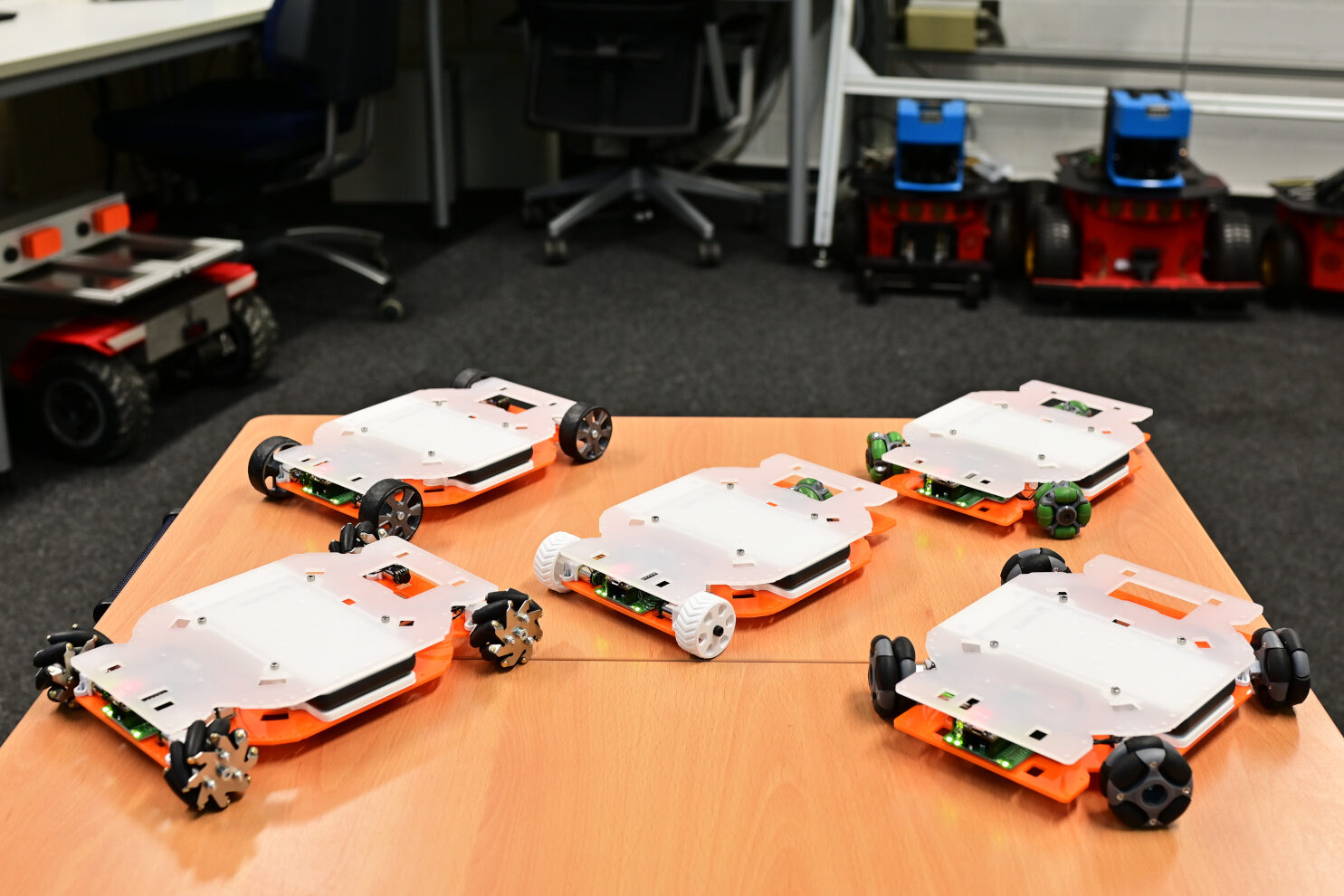
The robotics lab has a wide variety of robots available for use in teaching and for working on thesis projects. However, they all share one major drawback: they prefer to move on their own rather than be carried. As a result, their area of application is limited to the lab itself and the adjacent rooms.
The robotics lab’s test area is not strictly necessary, particularly for basic training in mobile robotics—such as controlling different drive systems (Mecanum, omni-wheel, or differential drive), implementing control system tasks, and integrating sensors. This led to the need to develop a flexible platform capable of supporting all drive types, one that is small enough to be carried in a backpack to a home office.
Possible Configurations
EduRob can be equipped with three or four motors and different wheel types. The motors can be flexibly repositioned by loosening two screws each, and different wheels can be attached to the motor shaft.
Mecanum
With four motors at the four outer corners, EduRob can be configured as a robot with a classic Mecanum drive system. Its movement characteristics are thus similar to those of OmniMan and the other IMSL Mecanum robots.
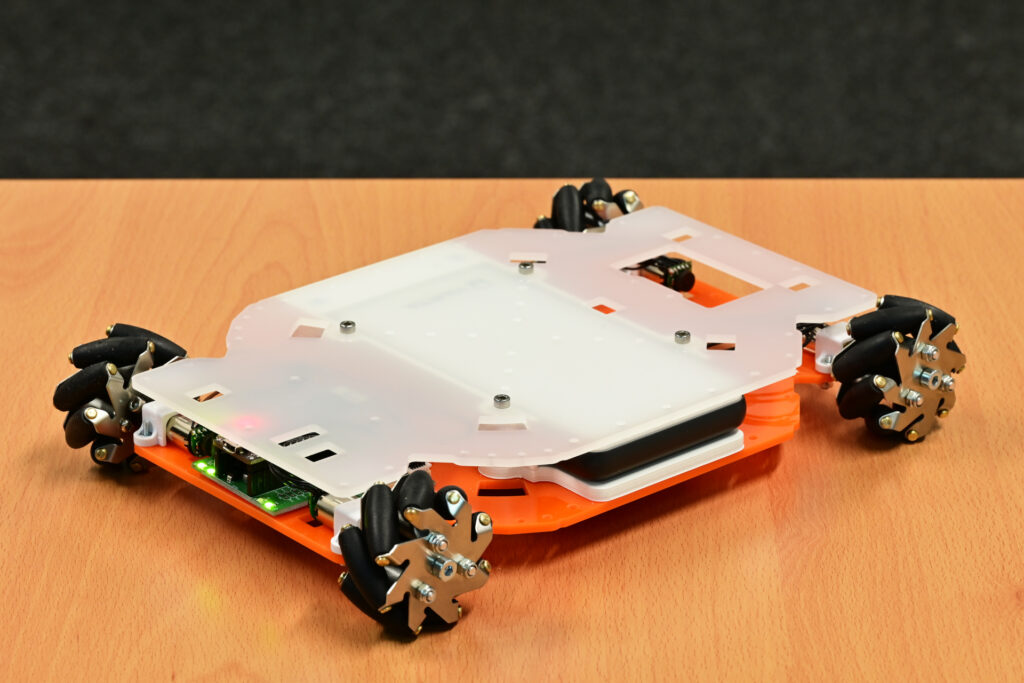
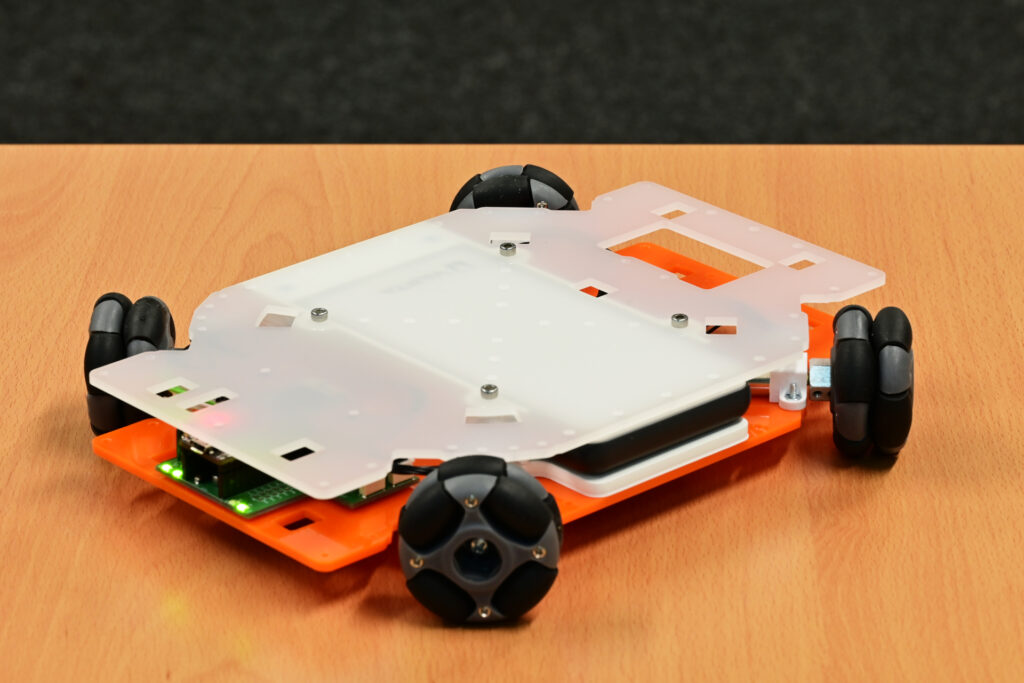
Omniwheel with three wheels (120°)
With three motors, EduRob can replicate the classic omniwheel configuration. Three wheels, each rotated by 120°, enable omnidirectional movement.
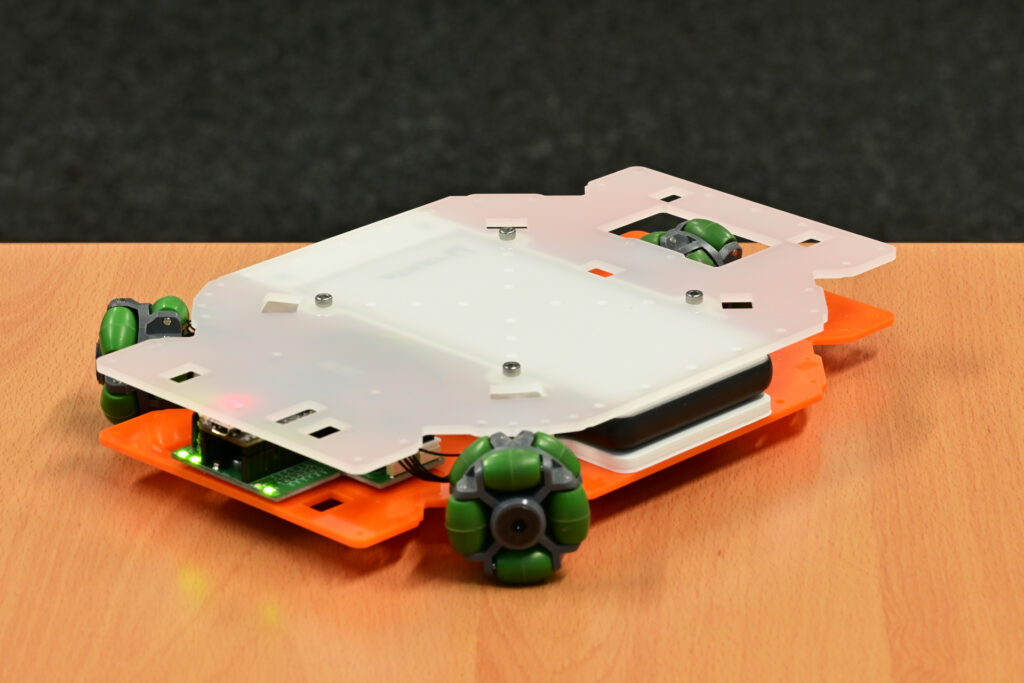
Omniwheel with four wheels (90°)
In addition to the classic arrangement with three omniwheels, EduRob can also replicate the special configuration with four omniwheels. In this configuration, the four omniwheels are arranged with each rotated by 90° relative to one another. Compared to the Mecanum arrangement, the wheels are effectively rotated by 45°. EduRob is also capable of omnidirectional movement in this configuration.
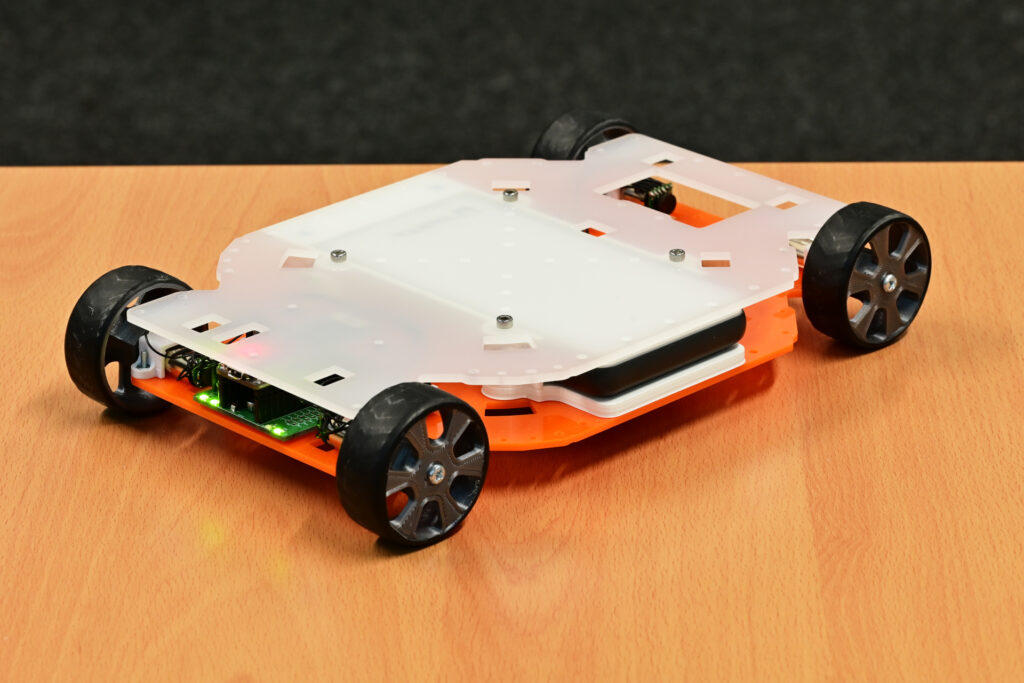
Differential Drive or Skid-Steer Drive
The Pioneer robots in the IMSL fleet are able to maneuver thanks to their four-wheel configuration. Although the wheel arrangement corresponds to the Mecanum configuration, the use of conventional wheels without free-rolling casters prevents sideways movement. In addition to forward and backward movement and rotation around the center of the platform, the robots can travel along circular arcs. This type of drive system is also known as skid-steer drive. Thanks to the 4×4 drive system, this configuration is particularly well-suited for uneven terrain. Since the wheels lack free-rolling rollers, they are less prone to becoming clogged or jammed.
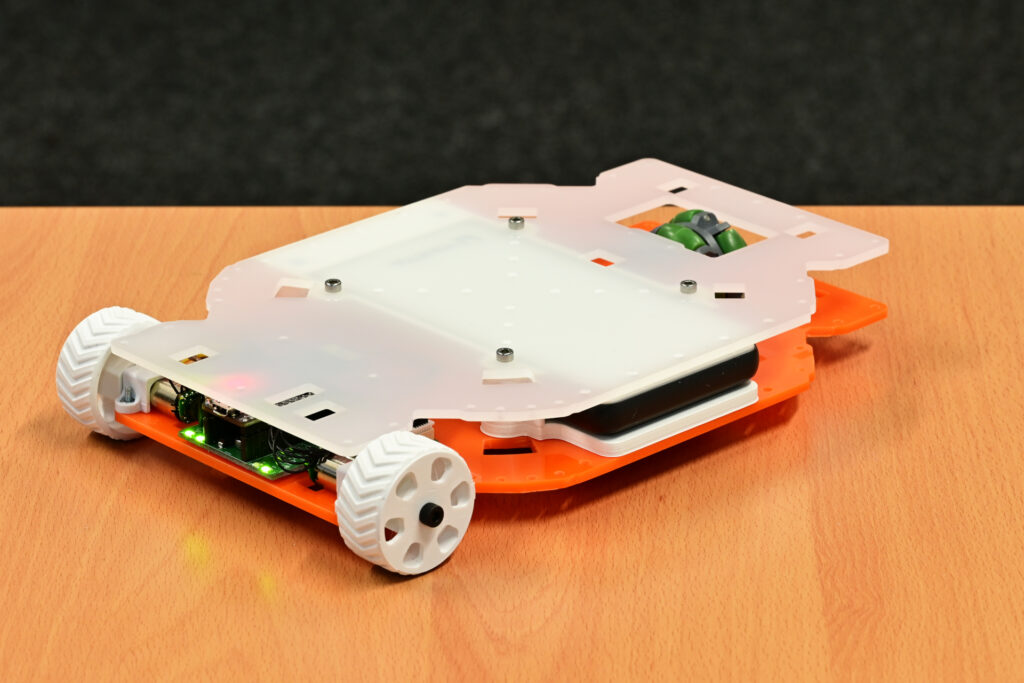
By using two conventional wheels and one or two non-driven omniwheels, true differential drive is also possible. In this case, the pivot point shifts to the center between the two driven wheels. While this affects the robot’s turning on the spot (the front section swings out), it retains its limited range of motion (forward, backward, turning, and traveling in arcs). “Off-road capability” decreases due to the reduction to two driven wheels, and the use of omniwheels increases the risk of dirt accumulating on the free-rolling wheels.
Components
In addition to its modular drive concept and a USB power bank for power supply, EduRob is equipped with a specially developed control board. The control board, based on the ESP32 family, includes drivers for the motors and enables connection via Bluetooth and Wi-Fi to laptops and smart devices. A ROS interface is available, allowing algorithms provided by ROS to be used.
Many thanks to Plottwerkstatt Design for manufacturing the EduRob’s panels.
Team
EduRob is being developed by an interdisciplinary team of two IMSL staff members. Mechanical engineering and computer engineering make EduRob a versatile robot for educational purposes.
- Alexander Lel
- Alexander Miller