
Collaborative Localization and Positioning of Mobile Devices in Indoor Environments
The goal of the “HATOX” project is to develop a novel wireless remote control system based on ultra-wideband (UWB) technology. At the core of the system are specialized wireless nodes—to be newly developed—that will be equipped with a UWB transceiver. By performing reciprocal time-of-flight (ToF) measurements of radio signals between fixed and mobile nodes, the unknown positions of individual participants can be determined. UWB radio technology is particularly notable for its high ToF measurement accuracy and favorable coexistence characteristics with other radio traffic.
The proposed system is intended to utilize the “collaborative localization” approach based on the ToF measurement method known as “Three-Message Double-Sided Two-Way Ranging.” In this context, collaborative localization represents an extension of cooperative localization. Cooperation is achieved through the use of special nodes, known as host tags, which enable the self-localization of mobile objects, and the position information obtained in this way can be used to locate other nodes. Furthermore, cooperative localization is enhanced with machine learning methods. By utilizing specific parameters of the UWB signals, the system aims to learn the characteristic error behavior of UWB measurements as precisely as possible. This approach addresses the fact that the quality of radio measurements is strongly influenced by environmental factors. Therefore, relying solely on static error models is often insufficient. By using AI-based methods to detect and correct measurement errors, this problem is to be mitigated, enabling reliable operation of the system in various deployment environments.
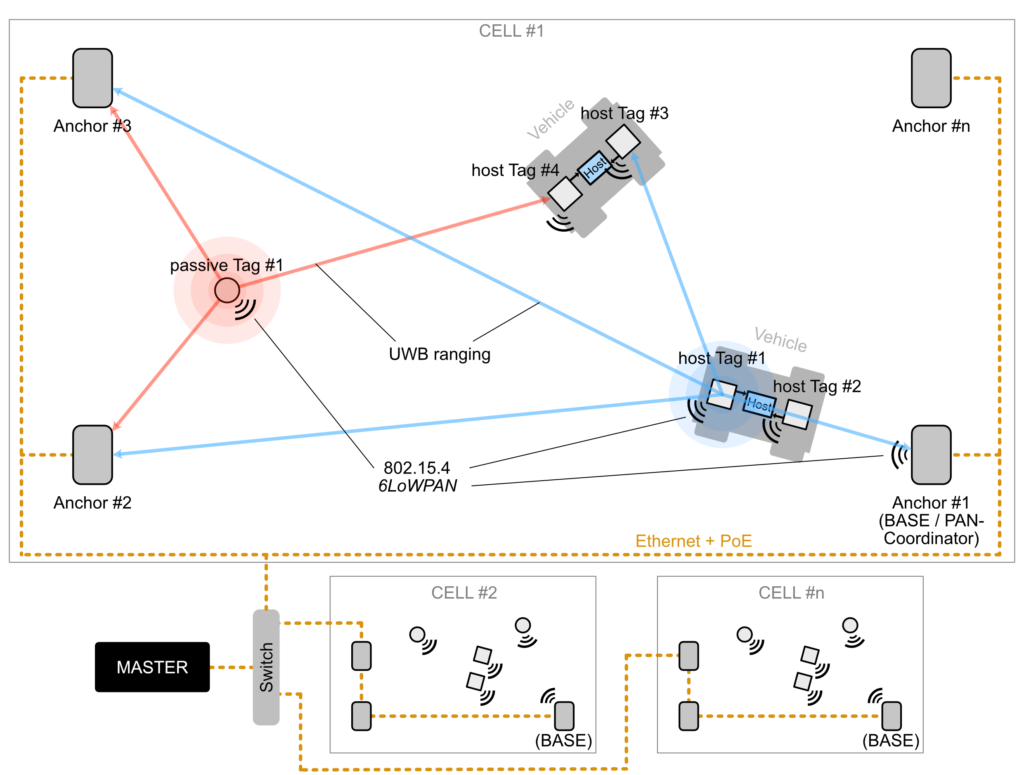
The proposed methods for collaborative positioning with AI-based error correction increase the coverage of the operational environment with radio infrastructure or allow for a reduced radio infrastructure while covering the same area. The position of mobile nodes can thus be determined even in locations where this would not be possible with traditional algorithms. In addition, the robustness, reliability, and accuracy of the overall system are enhanced. A modular approach to the development of the radio nodes also allows for application-specific integration of additional sensors, such as inertial sensors. Special variants of the radio nodes are also to be equipped with PLC functions.
Use cases include the tracking of highly specialized machines, vehicles, and/or industrial remote controls. To this end, the radio nodes are attached to or integrated into the corresponding devices. The planned system is also intended to address issues related to personal safety. Upon completion of the project, a cost-effective, adaptive, real-time radio-based localization system with reduced installation and administrative overhead and high positioning accuracy is expected to be available.
Project Partner

Funding
Funding Code
KK5119001BD0