Introduction and Objectives
Modern mobile devices such as smartphones are often equipped with Bluetooth and Wi-Fi (IEEE 802.11a-g) in addition to second-generation (GSM/GPRS/EDGE) and third-generation (UMTS/HSDPA) cellular interfaces. By supporting various wireless transmission technologies, smartphones offer great potential for teleservices in a wide variety of application scenarios. Depending on the application scenario, UMTS can be used in urban areas, GPRS or EDGE in rural areas, and Wi-Fi in buildings. If diagnostic data needs to be retrieved from a technical system on-site, this can also be done directly via Bluetooth. However, the individual technologies have very different characteristics, which must be taken into account by the mobile application—especially when response behavior plays a role, as it does in teleservice. The transmission characteristics of a wireless technology can be described by the achievable data rate, the delay (round-trip time, RTT), and the variation in delay (jitter). One objective of the research project is to measure these parameters using commercially available smartphones under various operating conditions on the T-Mobile Deutschland GmbH network. The study examined the limitations of wireless technologies, the network infrastructure (speed proxies, firewalls), and the mobile devices themselves. As a further objective of the project, a communication architecture was designed that enables a user to access a technical system either via Bluetooth or via IP-based interfaces (Wi-Fi/cellular networks).
Results
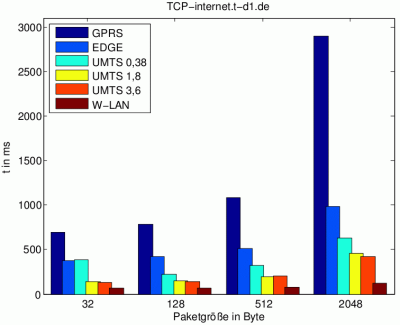
The measurement results show that the maximum theoretically possible data rate is not achieved due to limitations in the end devices, including system software. Furthermore, components of the network infrastructure cause additional delays in data packets. Figure 1 illustrates the RTT for various mobile communication interfaces and packet sizes during transmission using TCP.
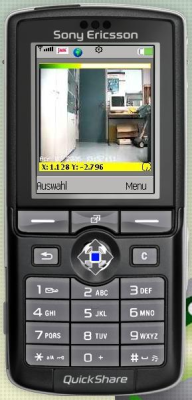
Based on the results of the measurements, the teleservice system was designed to include separate control and data channels with different priorities. The prototypical teleservice system enables the monitoring of technical systems via heterogeneous wireless technologies using a Java-enabled terminal device. The system consists of client software implemented in J2ME (Java 2 Micro Edition) and a server that receives commands from the client and returns data and video images from the system. It was implemented as an example for a mobile robot and tested with various mobile devices and different wireless technologies. On the server, the video images are individually downscaled to fit the display size of the respective device and compressed to minimize the transmission time of individual frames and make the best possible use of the device’s display. The transmitted video image is enriched with additional data on the server. Figure 2 shows the robot being operated via an emulator from Sony Ericsson. The developed system was presented at T-Mobile’s “Zukunftstag West 2008” on May 28, 2008, in Neuss.