
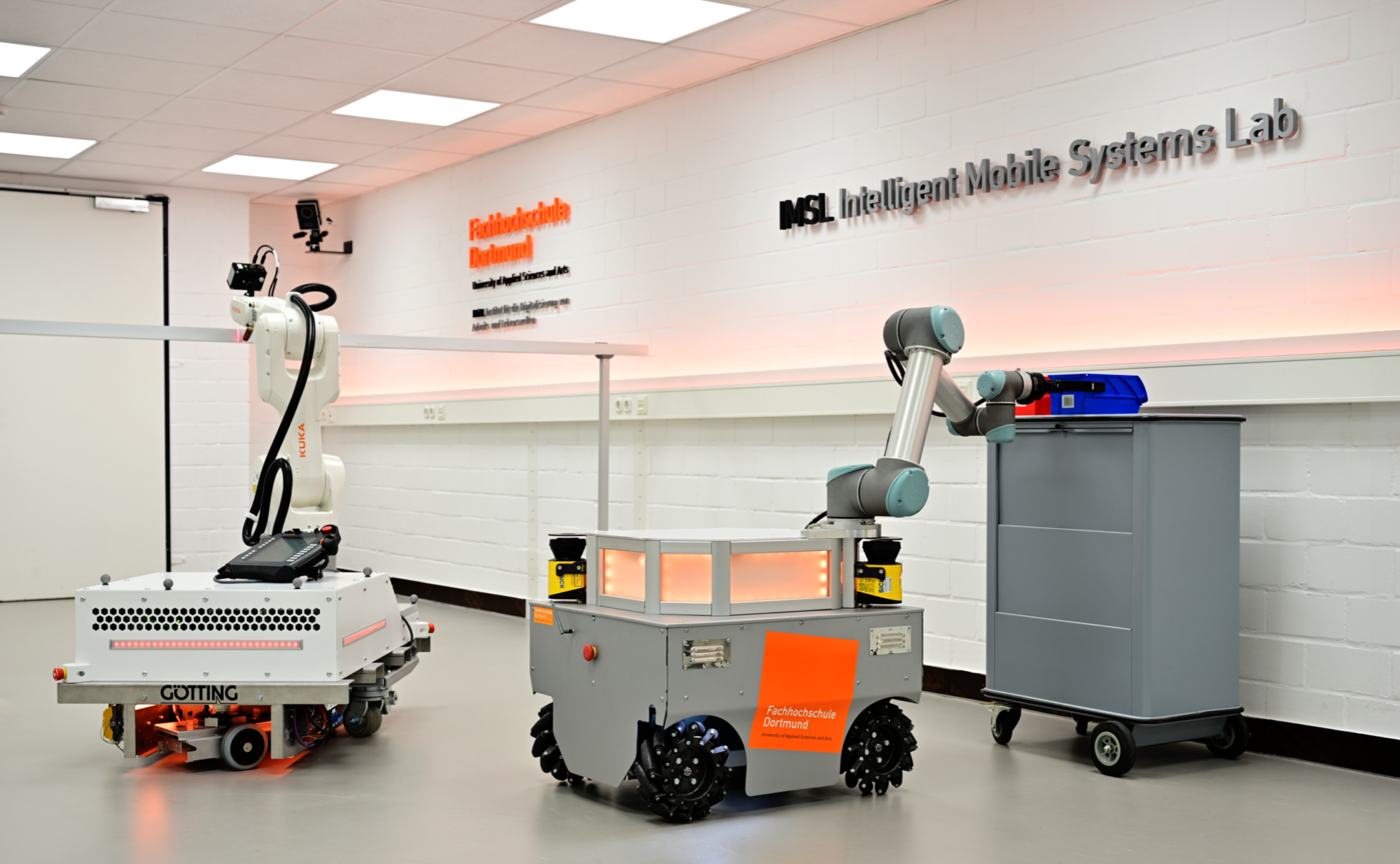
In the Robotics Lab, robotics-related projects at IDiAL are technically implemented and evaluated. Thanks to the lab’s outstanding equipment and its proximity to the workshop, it serves as an ideal incubator for prototypes. On the lab’s large test area, the hardware of the developed prototypes can be tested through physical experiments. However, the lab’s primary focus is the development and evaluation of algorithms for the localization and navigation of mobile robots. For example, filters for localizing mobile robots can not only be tested but also objectively validated using the existing motion tracking system. A collection of various mobile robots with different propulsion systems and movable obstacles also allows for a pure focus on software, thereby providing a good working environment for teaching and thesis projects.
Facilities
Workstations
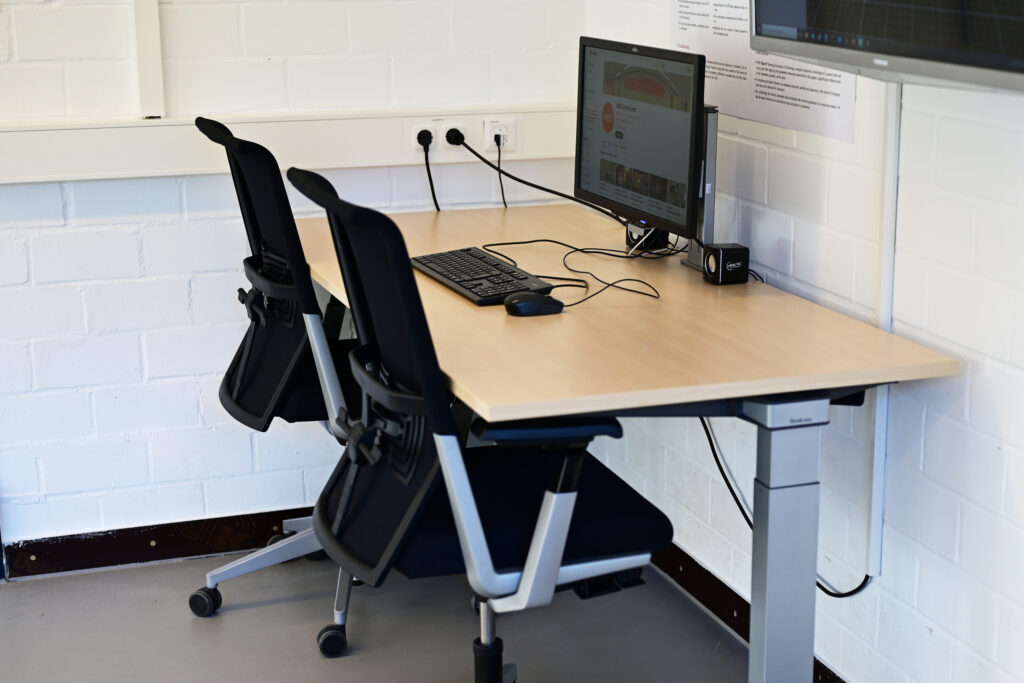
The robotics lab has three workstations. Two (laptop) workstations are intended for use with students’ own computers. Another workstation features a permanently installed Linux PC and can be used while standing or sitting. In addition, a high-performance PC for visualization is connected to a television, on which, for example, data from the motion-tracking system throughout the entire lab can be viewed.
Motion Tracking
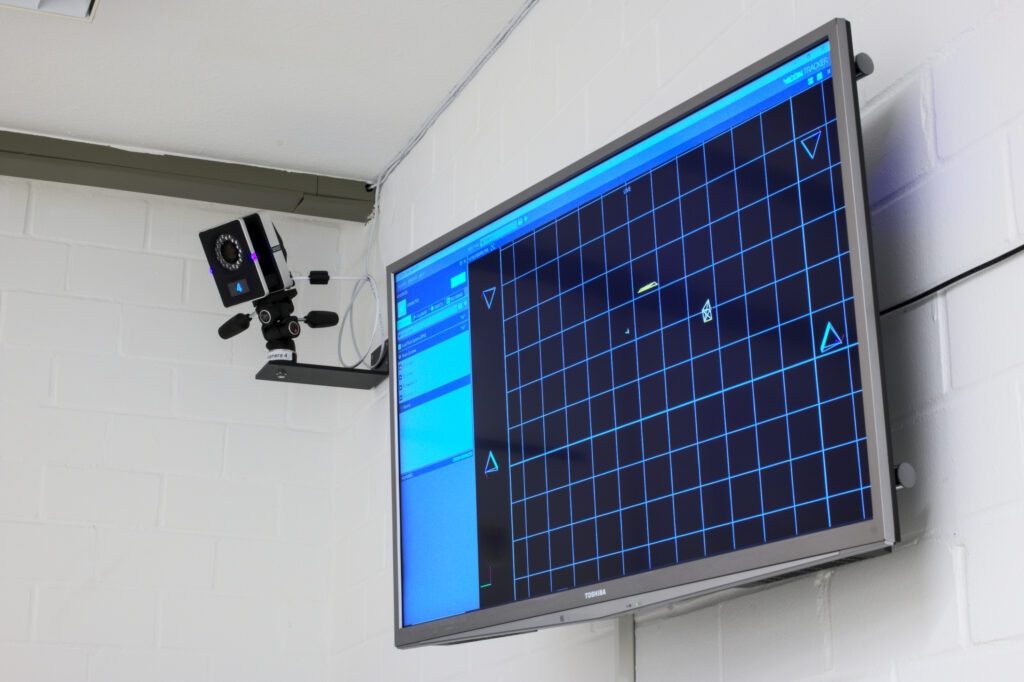
A motion-tracking system from Vicon is available in the lab. Four cameras mounted in the corners of the room cover a large portion of the lab’s floor space. The system supports 3D tracking of objects that have been fitted with reflective balls.
Collection of various mobile robots and mobile manipulators
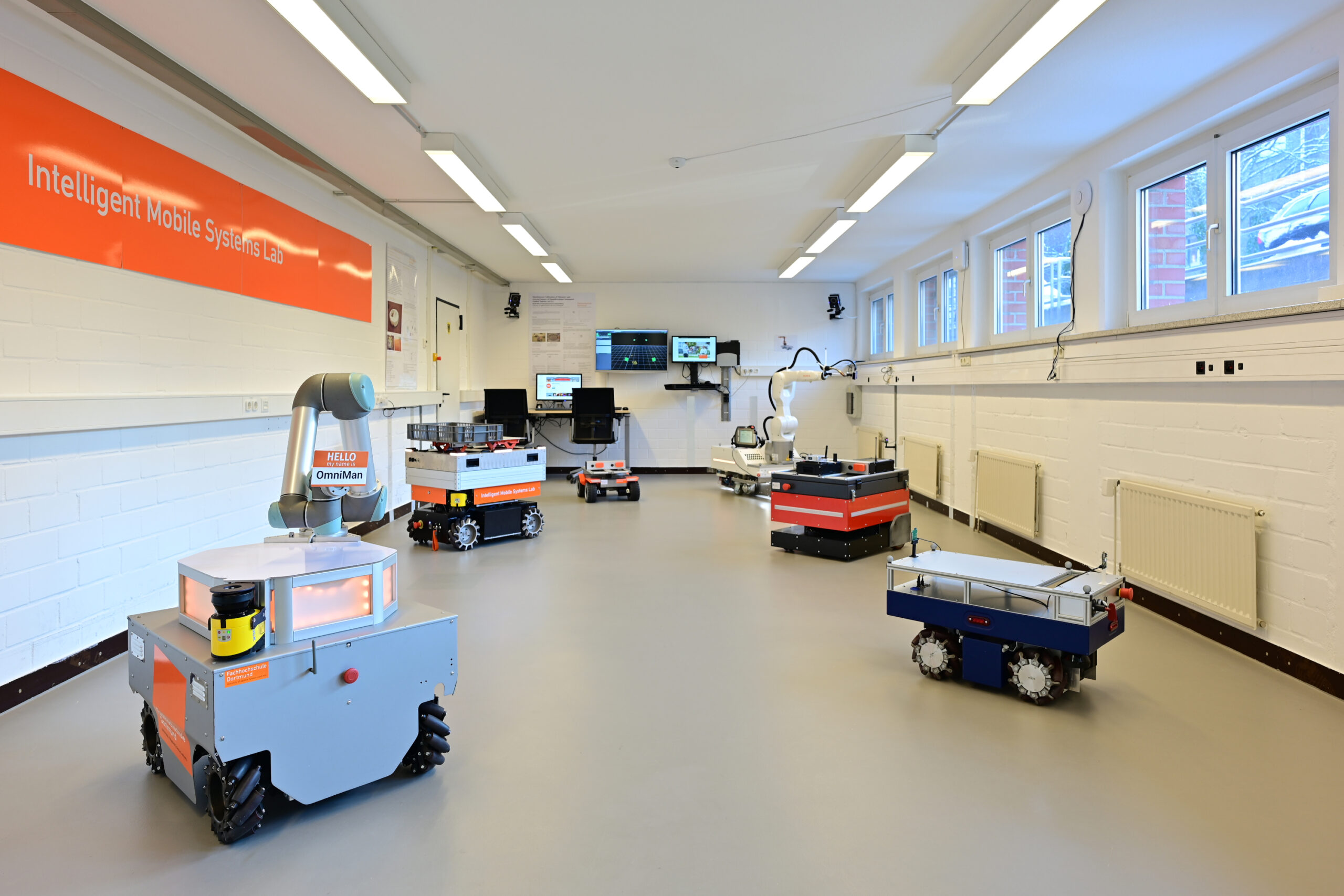
The robotics lab is home to a wide variety of mobile robots and mobile manipulators. In addition to classic teaching robots from the Pioneer series (with and without grippers), the lab also houses platforms with omnidirectional drives (Mecanum) in various sizes. Among these, OmniMan stands out as an omnidirectional mobile manipulator. It combines a Mecanum chassis (all degrees of freedom in the plane) with a Universal Robots UR5 robotic arm (6 degrees of freedom in space) to form a flexible integrated system. For localization, safety laser scanners and the RFID reader mounted under the vehicle can be used. In addition, various robotic vacuum cleaners and other omnidirectional platforms of different sizes are available.
Passive and Active Landmarks
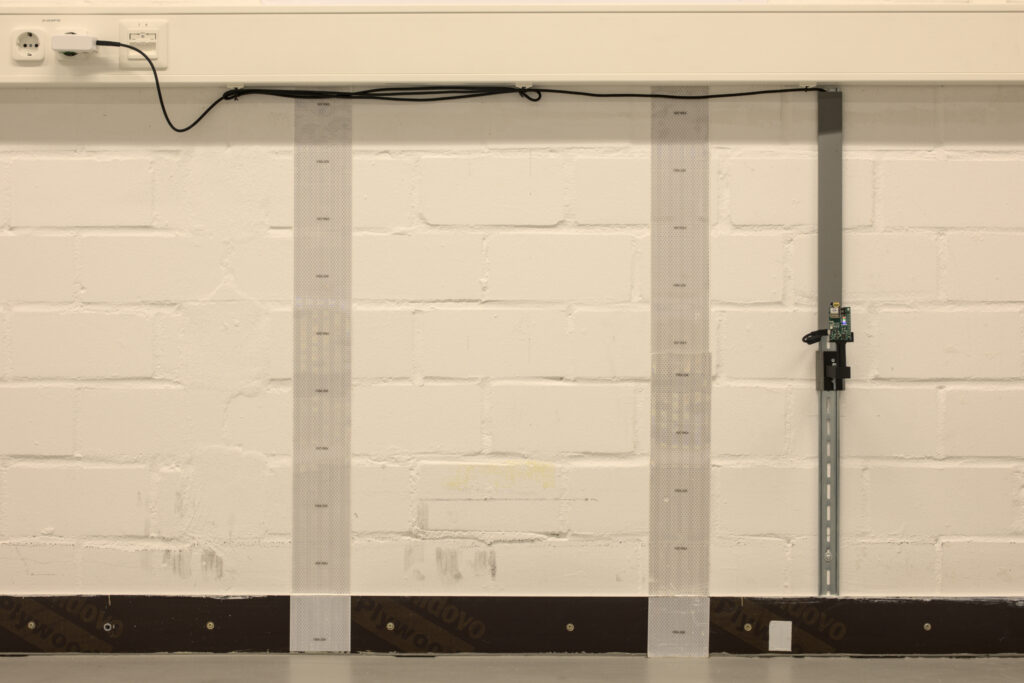
Passive reflector markers for detection by laser scanners, as well as active ultra-wideband radio nodes serving as artificial landmarks, are installed at strategic locations throughout the laboratory.
Cast Floor with RFID Tags: NaviFloor®
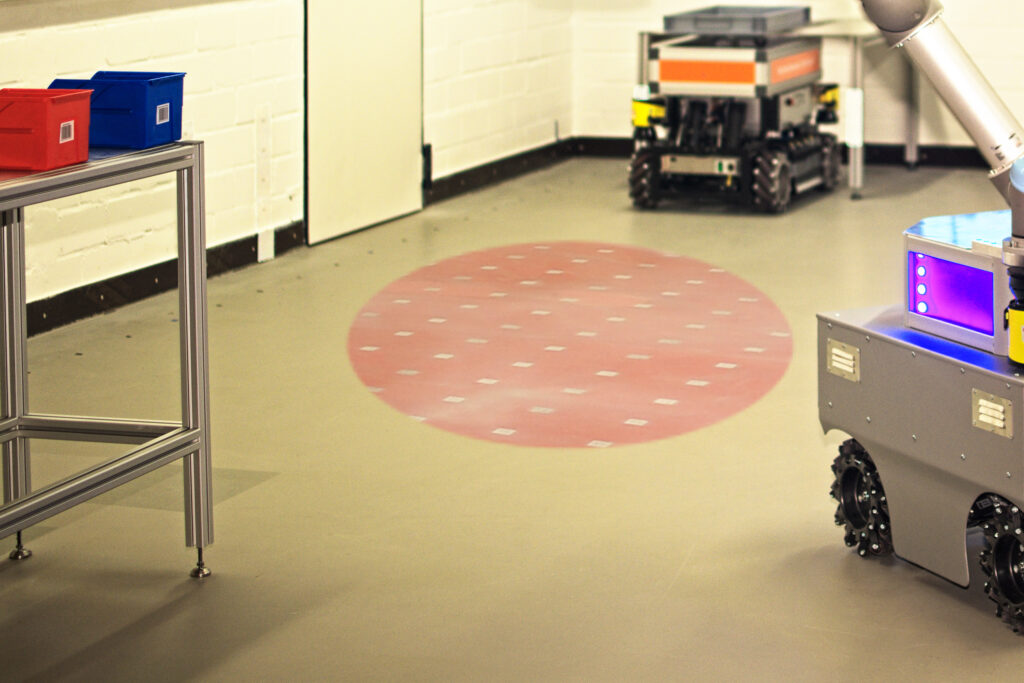
The floor of the robotics lab consists of a flat, seamless poured concrete surface. A total of 831 RFID tags are embedded in the floor at 12.5 cm intervals. These tags can be read by the mobile robots using the available readers, allowing the robots’ positions to be determined based on the known locations of the tags.
Robot Fleet
The robotics lab is home to various robots. These are used in both research and teaching.