
Abstract
Due to demographic change, outpatient and inpatient care for older adults is becoming increasingly important. Under the umbrella term “Ambient Assisted Living” (AAL), technical support systems are being developed to enable older adults to live safely at home or in a care facility. However, the AAL systems commercially available to date are largely closed systems and do not offer open interfaces to other systems or devices. The goal of the project is to develop an assistance system that can integrate additional end devices and services through open interfaces. The system is designed to support various life phases and levels of assistance, ranging from independent living in one’s own home, through outpatient care, to inpatient care in a nursing home. It is crucial that the individual components can be easily retrofitted into existing homes and care facilities, which will be achieved technically through a combination of wireless sensor data collection and data communication over existing power lines via Powerline Communication (PLC). The wireless network is used to collect sensor data such as room temperature, lighting, etc. and consists of both stationary nodes—such as adapters plugged into electrical outlets—and mobile nodes, such as tags for fall detection. Especially in the home environment, preventing and detecting emergencies is a top priority. One of the most significant risks—a fall by an older adult—must be detected as quickly as possible and reported to an emergency center. The wireless network’s localization function is designed to facilitate easy setup and activity monitoring. Furthermore, social and neighborhood-based services are to be integrated into the assistance system. The research project places the needs of older adults and care staff at the center of its research efforts. Potential application scenarios are derived from the everyday experiences and needs of older adults and are evaluated for feasibility in collaboration with application partners in both outpatient and inpatient care.
Project Objectives
The goal of the proposed project is to develop an assistance system designed to improve the quality of care and quality of life for older adults, which should meet the following criteria:
- Various levels of assistance, ranging from independent living in one’s own home, through outpatient care, to inpatient care in a nursing home
- Detection and prevention of emergencies, as well as reduced response times in emergency situations
- Empowering care recipients in their self-determination and sense of freedom, while relieving care professionals of the constant pressure of having to monitor residents
- Cost-optimized retrofitting for existing buildings
- An intuitive operating concept and secure commissioning based on the plug-and-play principle
In addition, the following technologies are to be used:
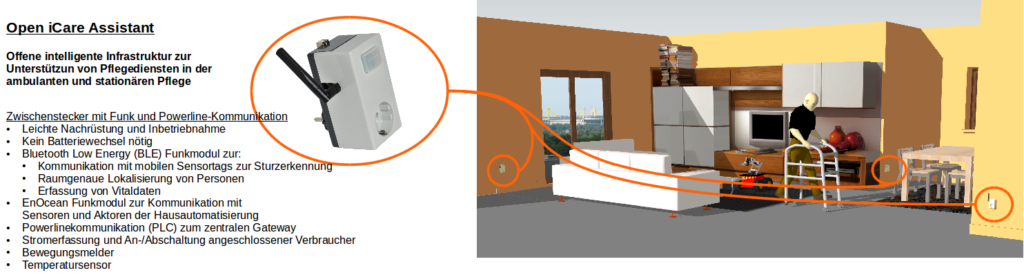
- A wireless network consisting of stationary nodes (such as adapters plugged into electrical outlets) as well as mobile nodes worn by the user (such as tags for fall detection)
- Real-time localization for fine-grained activity monitoring; communication via existing power lines, which integrate the distributed nodes into a single system
- Modular software architecture of the overall system, for optimal scalability
To ensure the targeted transfer of the results in North Rhine-Westphalia, a reference implementation of a market-ready prototype is to be integrated into the model apartment of the Research Institute for Technology and Disability (FTB).
Partners
Funding